
Raising the Bar: How Global Consultation Shaped The Long Run’s Global Ecosphere Retreat® standard 3.0
The Global Ecosphere Retreat® (GER) Standard has always been designed as a living framework, one that reflects the realities of delivering conservation, community impact, cultural stewardship and commercial resilience through tourism.

Global Ecosphere Retreats® uphold excellence at the intersection of nature, people and tourism
In 2024, The Long Run undertook a global public consultation to review and strengthen the GER® Standard. Version 3.0 is the result of that process. It reflects not only what we set out to improve, but where we were challenged to go further.
The consultation engaged contributors across multiple regions and disciplines, including Long Run members, external experts, and independent reviewers from academia, global institutions, and leading sustainability organisations.
Contributors were explicitly invited to challenge the Standard, to identify gaps, push its ambition, and ensure it continues to set a meaningful benchmark for nature-based tourism.
Feedback was gathered through structured written submissions, detailed document reviews, and direct commentary.
Many insights reinforced the framework's strength. Others challenged us to go further, particularly in how the Standard is applied, measured and verified in practice. Some of that feedback was uncomfortable, but necessary.
Constructive Feedback.
Several consistent themes emerged from the consultation.
Clarity and Usability Must Match Ambition
While the GER® Standard was widely recognised for its ambition, contributors highlighted the need for clearer language and structure, greater consistency in interpretation and more practical guidance on implementation.
Credibility Depends on Stronger Verification
There was a clear call to strengthen: distinctions between levels of non-compliance, transparency in assessment processes, and accountability mechanisms that reinforce trust.
Measurement Must Be More Consistent and Actionable
Feedback emphasised the need for more structured data collection, consistent reporting approaches, and stronger links between measurement and decision-making.
Impact Extends Beyond Site-Level Operations
Contributors encouraged a broader view of responsibility, highlighting the need to consider value chains, indirect impacts and system-level influence
Community and Indigenous Engagement Must Go Deeper
There was a strong push to strengthen the recognition of Indigenous communities as rights-holders, work on the deeper integration of Traditional Ecological Knowledge and drive meaningful, accountable participation.
Download the updated Global Ecosphere Retreat® standard here
Enhanced criteria.
The standard is divided into five sections and contains the following key changes:
Commitment (formerly business requirements): Expanded business governance requirements reflect the importance of embedded purpose.
Commerce: Strengthened requirements for financial resilience, sustainable procurement, and risk management.
Conservation: Refined to address the importance of nature restoration, climate crisis resilience, and landscape connectivity, with integrated water risk management and aspirational environmental targets in line with global climate targets.
Community: We have elevated the importance of and expanded external community collaboration, and within the internal community focus (employees), we have expanded requirements for well-being, mental health support, and diversity, equity, and inclusion.
Culture: Enhanced and refined existing criteria with additional points focused on business culture (internal).
The Standard has also expanded in depth, increasing from 89 to 125 criteria, to provide greater specificity and clarity.
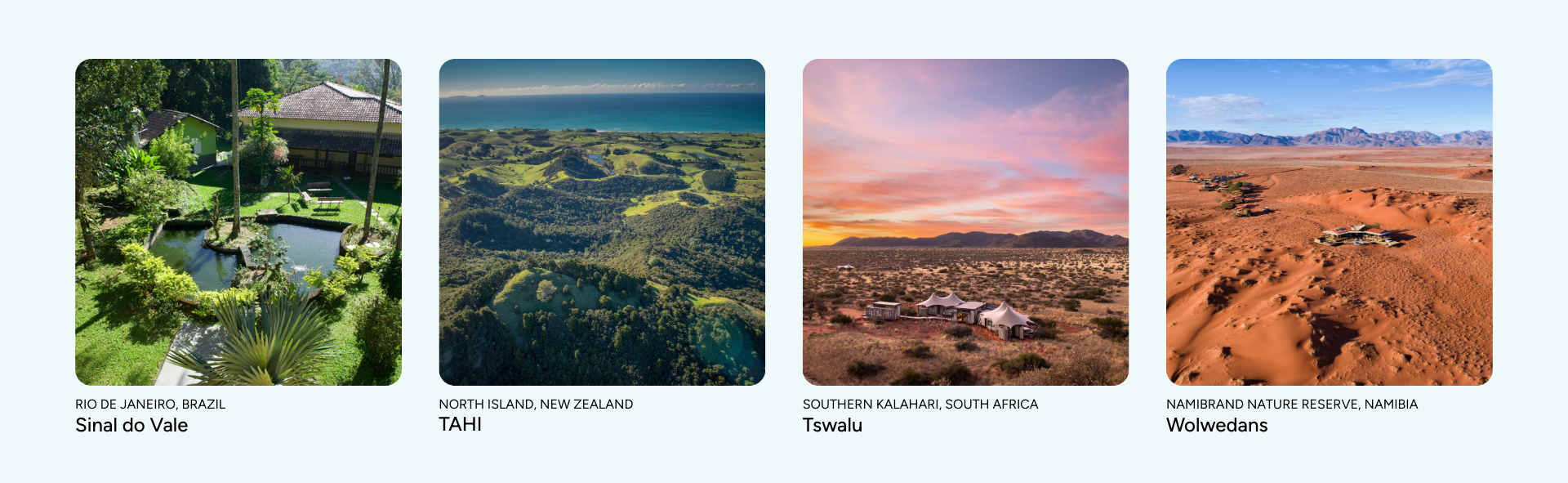
Global Ecosphere Retreats® uphold excellence at the intersection of nature, people and tourism
Better benchmarking.
The standard is also benchmarked to exceed or align with:
The Sustainable Development Goals
The IUCN Green List
ESG frameworks
As part of this evolution, Version 3.0 has been systematically benchmarked against the UN Decade on Ecosystem Restoration’s Standards of Practice.
This mapping exercise assessed the GER® criteria against the Standards’ principles and subcomponents, covering governance, biodiversity, community engagement, and adaptive management systems.
The analysis demonstrates strong alignment across key areas, including:
Long-term goal setting and adaptive planning
Transparent and accountable governance
Biodiversity assessment, monitoring and restoration planning
Structured reporting and continuous improvement systems
Inclusive stakeholder and community engagement
Importantly, the benchmarking also highlights where GER® extends beyond most other standards, particularly in:
Integrating sustainability across Conservation, Community, Culture and Commerce (4Cs)
Embedding sustainability within tourism operations and value chains
Emphasising organisational culture, guest engagement and commercial responsibility
This ensures that the GER® Standard is grounded in globally recognised best practice, while remaining practical and relevant within the tourism context.
An Ongoing Evolution
Version 3.0 is not an endpoint. It is a step forward, shaped by the insights of those working across conservation, tourism, policy and practice. As expectations continue to evolve, so too will the Standard that supports those working to deliver impact on the ground.
Acknowledging Our Contributors
We extend our sincere thanks to the individuals and organisations who contributed their time and expertise to this consultation. Their perspectives, spanning academia, global institutions, and industry, have played a critical role in shaping Version 3.0.