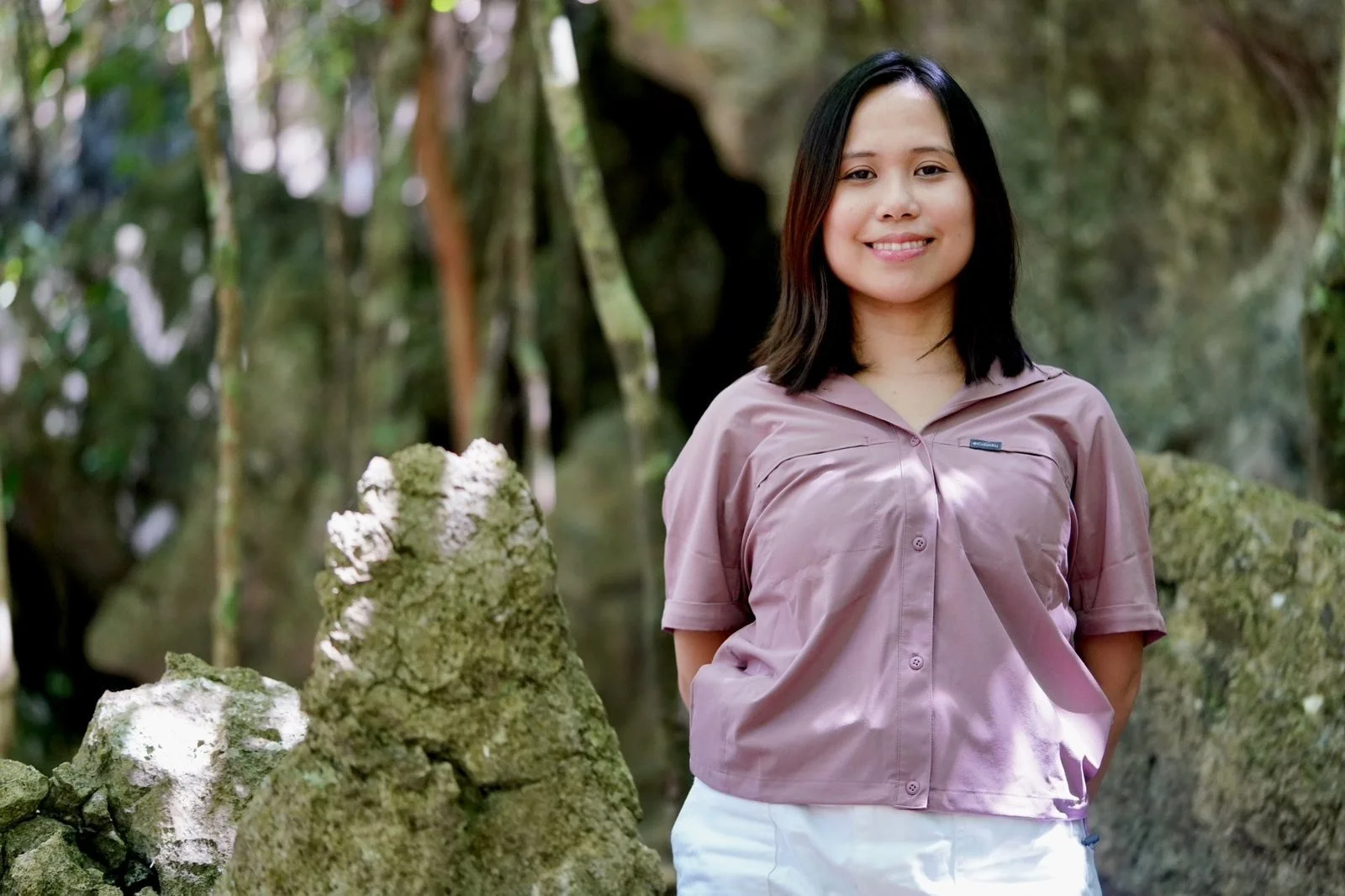
Billie spent her teens at a rock formation instead of the mall. Today, she protects this ‘last ark of biodiversity’ in the Phillippines.
To me, the Masungi Georeserve is not just a geotourism project or a conservation project 45 kilometres east of Manila. It’s actually a family legacy. You will see me here in my jeans, following the footsteps of my father who was a civil engineer. He had won a public bidding to develop a sustainable project in the vicinity of the Masungi rock formation in the province of Rizal. And that’s when our story started.
Credit: Tswalu Pangolin Research, Oppenheimer Generations.
The vision of the project was to promote the optimum use of the land with minimum disruption of the existing ecosystem and the maximum preservation of the environment and enhancement of the land’s natural attractions. These were the exact words in the supplemental joint venture agreement signed between Blue Star and the DNR back in 2002.
Your suspicions are correct: I took this photo in the early 2000s using my Pokémon camera. This is how we saw the landscape at that time. It was barren and degraded. The limestone formations were exposed to the elements and there was barely any wildlife. When you asked the locals what you could hear all throughout the day, they would say that they would hear the buzzing sounds of chainsaws.
Fast forward almost thirty years. We now have a thriving secondary rainforest with (almost) a full forest cover. This is the result of hard work and commitment towards protecting a landscape that was slowly being threatened by urbanization and aggressive development.
Today, the Georeserve hosts more than 800 species of plants and animals. Instead of hearing the buzzing of chainsaws, you can now hear the humming of birds or the buzzing of the bees.
We have over 100 birds, 30 species of bats, and our very own microsnail called the Masungi microsnail. We discover lost new and rare species every year together with our partner scientists and schools.
Credit: Tswalu Pangolin Research, Oppenheimer Generations.
In 2016, we decided to open this place that we love to the public, opening select and small areas of the georeserve for responsible visitation.
Only one group can enter at a time and all visits had to use an online reservation system to manage the capacity of the georeserve. Thankfully, it was welcomed with very enthusiastic response from the Philippine population and it instantly became a viral sensation and destination in the Philippines in 2016.
There were two reasons why we opened this to the public despite initial hesitation.
One is that we needed more advocates for the area. We know that if a tree falls somewhere and people haven't seen it for themselves, no one would hear about it. But if a tree fell inside a place that people have seen with their own eyes, then people have a reason to care. Ultimately, we need to make people care for, and advocate for, Masungi Georeserve.
Number two is really on the practical side of sustaining the conservation effort. For many years, it has only been the private sector, our company, that has financed all of the protection efforts. But it is never cheap to protect a 300 hectare area. And so we needed to find a way to employ rangers to sustainably manage the site without destroying or disrupting its natural ecology.
The Masungi Georeserve Discovery Trail became popular for its low impact structures that mimic the natural forms that surround it.
Instead of building concrete viewing decks, we built interesting shapes and colours inspired by nature.
Credit: Tswalu Pangolin Research, Oppenheimer Generations.
This is the Sapot, which is a viewing deck that overlooks the largest lake in the Philippines. It’s a suspended cable platform across limestone pinnacles.
This is Tatay. It’s one of the highest areas in the Discovery Trail, which is a total of 6 to 7 kilometres, or 3 to 4 hours of hiking.
One important part of our story is our rangers.
Today we have up to 100 park rangers working on the reforestation and working on the Georeserve. And one thing that we have worked on with them is really to make sure they have a stake in the experience. Such that highlights on the trail are named over their own caretakers i.e. the rangers who discovered that specific area or highlight.
This is Yungib Ni Ruben which means The Cave of Ruben.
Ruben is the name of one of our oldest park rangers who studied the area to know where we can build the trails and which paths, nooks and crannies would give tourists safe yet creative and enjoyable access to the limestone ecosystem.
Ruben was a former illegal logger. When we first met him, he was a very shy person. He didn’t like to talk. But now he has the pride of being the discoverer of this cave. And now he confidently shares the story of Masungi with visitors from all over the world.
Now, in 2017, our challenge became even bigger. We had an environment minister in the Philippines that was keen on replicating our business model. She asked us to restore 2,700 hectares more of degraded land around the Masungi Georeserve and inside critical watersheds that are sheltering Metro Manila (filled with 20 million residents) from climate change, flooding and landslides.
This is so important because the Philippines is one of the countries most impacted by the climate crisis. Forests here are not just green spaces. They are life support systems. The watershed that Masungi sits inside acts as a water sponge for chronically flooded Manila: it soaks up the rains before they reach the 20 million people downstream. And yet only 25% of it is forested today, despite being protected by law since 1904. This watershed is already on life support. There really needs to be an intervention from civil society, from the private sector, from different walks of life to solve this very crucial life support problem.
This was the area that we needed to reforest back in 2017. As you can see, it’s all grasslands and it had been burned every year before we started working on that area.
Today, it is another area that is undergoing restoration. We have recovered 2,000 hectares for reforestation. We have rescued 4 pine groves (bear in mind these, these were the only standing trees when we started in the area). The pine cones are now germinating because they feel safe enough to be able to grow. We have established 15 monitoring stations, also known as ranger stations, across this new site. And we have 17km of trails, including those that were already existing for restoration purposes.
This wouldn’t have been possible without the support of many different sectors in the Philippines, including champions within and outside of government, the private sector, academics and the indigenous people.
Now this is important context because the Philippines consistently ranks as the deadliest country in Asia for environmental defenders. Obviously our business has our tourism component but we also have our advocacy component, which is not something that we are willing to forego for the sake of profit. We’re determined to engage in stories about our forest. Sometimes we get pushed back because of that but at the end of the day, we know our mission. And our mission is to preserve the limestone formation for decades to come. That is what guides us whenever we have a difficult decision to make.
That is my journey from being just a child following my dad, to becoming one of the defenders of the Masungi landscape. We continue to do so, because as much as it is difficult, it is also very meaningful.
I hope that everyone here who is doing something meaningful in their own community continues to do so, despite being told that it’s unreasonable. I hope that we recognize the importance of continuing the work that we do, our role in uplifting our society and in providing an example to the world of what is possible.