
What one tool has genuinely made you more productive?
This month, we asked our community of the world’s best minds in sustainable tourism:
Out of the tsunami of new technology, has there been one tool that has actually made a difference in your day-to-day?
Something that gave you time back for the work that matters.
Last month, we got wildly different answers to our question. This month, we saw two coming up again and again: Claude AI for knowledge work, EarthRanger for conservation management.
Claude AI
“All my founder friends were raving about Claude, so I couldn’t sit on the decision any longer.”

Lea C. Henzgen
All of my founder friends have been raving about Claude so we couldn’t really sit on the decision any longer.
We’re in the phase where we’re running an AI sprint at WANDLAY. It’s our April AI month, and we’re trying to automate as many of our processes as possible.
It has been incredible. It’s truly mind-blowing how much it can actually do.
We looked at different AI options and ultimately decided to go for Claude. We’re officially switching. Right now, we’re working through privacy settings and making sure the security standards are there before we take it any further.
Worth knowing: many in the industry are choosing Claude for ethical reasons. If you’re new to that conversation, Rutger Bregman’s piece in The Guardian is a good starting point.
“Claude is phenomenal at graphical formats.”

Dr. Andrea Ferry
I’ve found that Claude is better than the other engines at putting things into graphical representation.
ChatGPT is great for research and being a thinking buddy. But for taking what you give it and turning it into really nice formats, Claude is phenomenal.
I tried it with Singita’s data from last year, and it produced a really great report. I’m using it less for data tracking and more for data representation. The Excel workbook still does the tracking. Claude takes the data and turns it into something we can actually share.
"Tracking isn't just about what you see. It's about understanding terrain, reading signs, and knowing the wind."
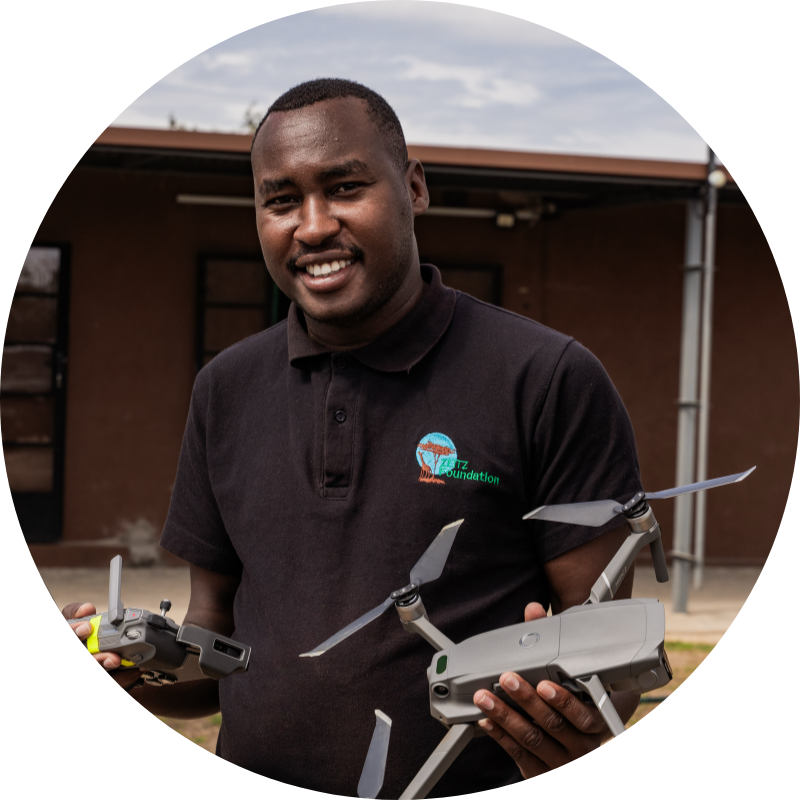
Simon Lokholi Nakito
rhino monitoring officer
ZEITZ Foundation hosted by Segera Conservancy, founding member since 2009
On guarding rhinos with old wisdom and new tools.
Simon Nakito has been at Segera for six years, starting as an intern and now leading wildlife monitoring across the conservancy. He learned to track from his grandfather, a ranger here in the 1960s. The toolkit has changed since then. Simon now combines that inherited knowledge with drones, GIS mapping, and EarthRanger.
After 60 years away, a founding population of Eastern Black Rhinos was translocated to Segera last June, returning the rhinos to a key part of their historical range. The work now is making sure they thrive, and that we don't lose them again. That means round-the-clock protection and monitoring, with a toolkit upgraded for the job.
EarthRanger sits at the centre of it. Every rhino at Segera is fitted with a GPS tag that sends real-time location to every ranger's app and to the operations centre. As Simon puts it:
"Technology has significantly enhanced our daily operations, particularly in data collection, representation, storage, analysis, and documentation. We rely heavily on EarthRanger for data collection and management."
The newer layer is drones, feeding straight into EarthRanger:
"We are in the process of integrating drones to help us with round-the-clock rhino monitoring. It means we can detect illegal activity, support rangers and canine units during patrols, check fence integrity to keep rhinos safe, and reduce the carbon footprint of vehicle-based monitoring."
“EarthRanger is like magic for us. It has replaced over 25 Excel sheets.”
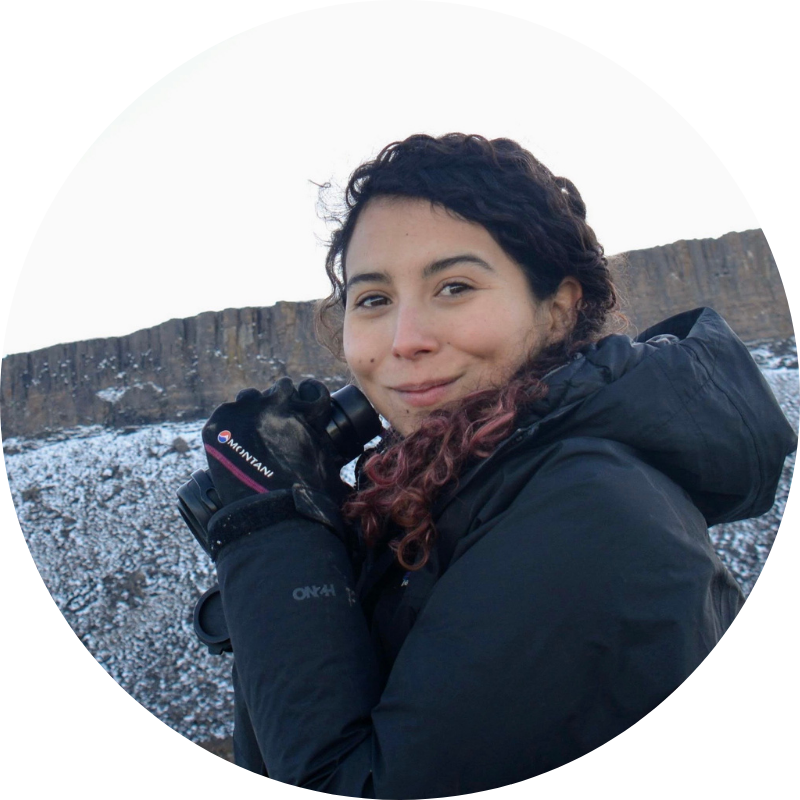
Solange Sabelle
lead researcher
Estancia Cerro Guido, member since 2025
On leveraging technology to prove pumas and sheep can coexist.
The fascinating story we kept coming back to was from Estancia Cerro Guido, in Chilean Patagonia, where EarthRanger is being used to settle a very old argument: can pumas and sheep coexist?
Cerro Guido operates as a boutique hotel, but ranching is at the core of its existence. There are more than 4,000 head of cattle and 18,000 sheep on the estancia.
“We are ranchers,” Gonzalo Sánchez, one of Cerro Guido’s managers, explained, “and as ranchers we have a historical conflict with pumas trying to eat our sheep.” In the past, estancias dealt with pumas the obvious way: they hunted them. Cerro Guido refused. “Culture in Patagonia is symbiotically linked with the economic activity that we do. Without a working estancia, you have no gaucho culture, and without gaucho culture, you have no Patagonia culture.”
So the team had to prove that ranching and conservation could work in the same landscape. “We want to explain to ranchers that there is a different way,” Gonzalo said. “That these two activities can work together in a balance. This is the scientific data that’s demonstrating that it’s possible.”
The science runs through EarthRanger.
Solange explains: “Pumas wear GPS collars. So do the sheep flock and their guard dogs. Every event in the field is logged in EarthRanger with a corresponding GPS point: a carcass found by a tracker, a camera trap deployed, a fecal sample sent for DNA analysis.”
EarthRanger becomes a bridge into the life of pumas and a way to see their interactions with sheep and guard dogs.
This data proves that pumas and sheep can, in fact, coexist.
Our community consists of 200+ of the best minds in sustainable tourism. What do you want us to ask them next?
We read every single message and your input shapes this newsletter - click the button below to let me know.